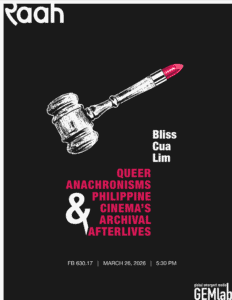
 Archival crisis subtends Philippine cinema. Lost films, collapsed archives, and limited access to surviving works are devastating symptoms of an anarchival condition. The flipside of fantasies of archival permanence and easy access, the term “anarchival” describes the institutional precarity, archival scarcity, and circumscribed circulation of Philippine film history. Lim’s recent book, The Archival Afterlives of Philippine Cinema (Duke University Press, 2024) moves beyond mourning archival loss to instead foreground archivists’ and advocates’ resourceful practices of making do and their perseverance in the face of institutional constraints and state indifference.
Beginning with an overview of the book’s conceptual framework and keywords, the heart of the talk explores ABS-CBN Film Archives’ restoration of the 1982 film T-Bird and I (T-Bird at Ako, aka Lesbian Love, dir. Danny Zialcita). T-Bird and I was a star-studded box office hit that paired Philippine cinema’s rival female superstars – Nora Aunor and Vilma Santos – in a same sex romance, departing from the heterosexual romantic triangles of their previous films. Although T-Bird and I might strike contemporary viewers as heteronormative and transphobic, today’s globalized LGBTQ+ vocabulary is alien to the time of the film’s production and initial release. Drawing on queer feminist theory’s espousal of anachronism and queer Asian film studies’ attentiveness to translation and vernacularization, the talk reflects on the chronologically inappropriate terminology willfully wielded by queer feminist analyses of older works. It also teases out the film’s racialized star-fan dynamics, lesbian cinephilic pleasures, and exploration of Catholic heteronormativity under the Marcos dictatorship.
March 26th | 5:30 pm | FB 630.17
Bliss Cua Lim is Professor of Cinema Studies at the University of Toronto. Her first book on postcolonial temporality, transnational horror and the fantastic, Translating Time: Cinema, the Fantastic and Temporal Critique, was published by Duke University Press in 2009, with a Philippine edition by Ateneo de Manila University Press released in 2011. Bliss is a member of the Editorial Collective of the journal Camera Obscura: Feminism, Culture, and Media Studies and she also serves on the Advisory Boards of Plaridel: A Philippine Journal of Communication and Pelikula: A Journal of Philippine Cinema. Her recent book, The Archival Afterlives of Philippine Cinema, published in 2024 by Duke University Press, analyzes the crisis ridden history of film archiving in the Philippines. She is working on a next book project on queer Asian cinemas.